




This guide covers the practical side a first visit needs: current ticket prices, opening hours, what to see room by room, how entry on your pass works, and what sits nearby for the rest of the day. Prices carry a month tag throughout because Istanbul's gate fees move quickly.
| Dolmabahçe Palace quick reference (May 2026) | |
| Location | Beşiktaş, European shore, on the Bosphorus |
| Opening hours | 9 AM–6 PM, closed Mondays (last entry ~4 PM) |
| Individual ticket | ~1,250 TL (≈ $39 USD), full combined ticket |
| With your city pass | Entry included, pre-booked |
| Time needed | 1.5–2 hours for both sections |
| Best time to arrive | 9 AM at opening, or after 3 PM |
| Photography | No photos inside the state rooms |
Why visit Dolmabahçe
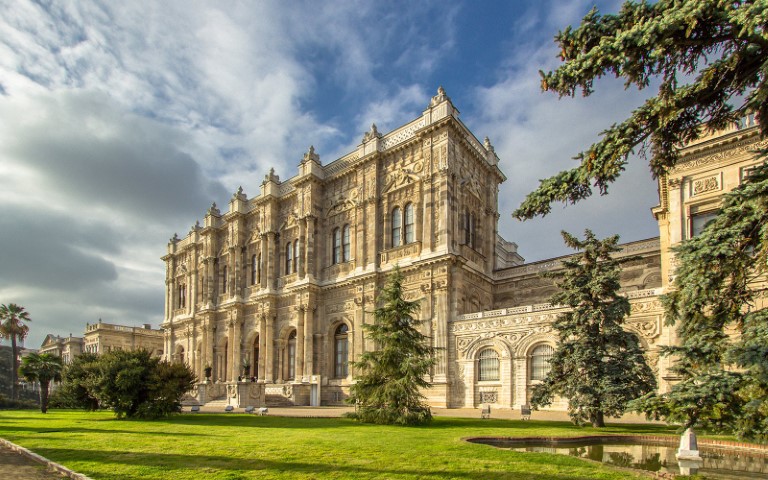
If Topkapı tells you how the early empire lived, Dolmabahçe shows you how the late empire spent. Built between 1843 and 1856 for Sultan Abdülmecid I, it cost the equivalent of millions in gold and helped bankrupt the treasury a fact the guides do not hide. The architecture mixes baroque, rococo, and neoclassical with Ottoman proportions, all facing the water along a 600-meter frontage.
It is also where modern Turkey closes one chapter and opens another. Mustafa Kemal Atatürk, the republic's founder, used Dolmabahçe as his Istanbul base and died here on 10 November 1938; the clocks in his room are still stopped at 9:05, the time of his death. For many Turkish visitors that single room is the reason they come. For the rest of us, it is the chandeliers, the staircase, and the sheer nerve of the place.
There is a useful contrast to hold in your head as you walk through. Topkapı, the court's home for nearly four centuries, was a cluster of low pavilions and shaded courtyards built for a sultan who ruled as an Eastern emperor. Dolmabahçe was built for one who wanted to be read as a European monarch symmetrical, gilded, and lit by gasoliers rather than oil lamps. The move across the water in 1856 was as much political theatre as it was a change of address, and the building wears that ambition in every cornice.
What to see, room by room
The palace splits into two ticketed parts, and the standard visit covers both. Go in knowing what to look for, because the guided flow moves at a steady clip and there is no re-entry.
The Selamlık and the Ceremonial Hall
The Selamlık (seh-LAHM-luhk, the public state rooms) opens with the Crystal Staircase, its double banister made of Baccarat crystal, a detail that stops everyone on the first landing. The sequence of reception rooms builds toward the Ceremonial Hall (Muayede Salonu), a 36-meter-high space under a four-and-a-half-ton chandelier of 750 lamps, a gift from Queen Victoria. The dome above it is painted to trick the eye into more height than there is.
The Harem and the Atatürk room
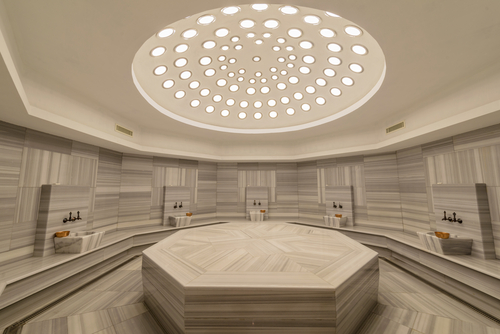
The Harem (hah-REM, the private family quarters) is quieter and more domestic, with bedrooms, the sultan's mother's apartments, and the bathrooms in Egyptian alabaster. At the end sits the room where Atatürk died, draped in a Turkish flag, the stopped clocks on the wall. It is a short, sober finish to a visit otherwise built on excess, and it tends to hush even chatty groups.
The gardens and the clock tower
Your ticket includes the seaside gardens, the swan fountain, and the four-tier clock tower by the main gate, this is the photo most people take before they realize the facade looks even better from the water. Give yourself 15 minutes out here at the end; after the gilded interiors, the Bosphorus light is a relief.
The details people walk past
Two things reward a slower eye. The first is the carpet collection, Hereke silk rugs woven on-site for the palace, including a single hand-knotted piece in the Ceremonial Hall large enough to cover a tennis court. The second is the alabaster bathroom in the Harem, carved from translucent Egyptian stone that glows when the light catches it, a quiet flex tucked away from the grand rooms. Neither is signposted hard, so listen for the guide and look down as well as up.
Worth knowing: a separate Palace Collections Museum and the National Palaces Painting Museum occupy outbuildings on the same grounds, with European and Ottoman canvases and the everyday objects of court life. They carry their own tickets and are easy to skip on a first visit, but if Dolmabahçe leaves you wanting more, they fill an extra hour without leaving the gate.
Don't miss The Crystal Staircase first room in, and the one photograph everyone wishes they could take (no interior photos allowed). The Ceremonial Hall chandelier 4.5 tons, 750 lamps; stand directly beneath it and look up at the painted dome. The stopped clocks at 9:05 in Atatürk's room the quiet heart of the visit. | |
Tickets, prices, and opening hours
The full combined ticket Selamlık plus Harem plus gardens runs about 1,250 TL (≈ $39 USD, May 2026); a Selamlık-only ticket is cheaper but skips the Atatürk room, so most visitors take the combined. The palace opens 9 AM to 6 PM and is closed Mondays, with last entry around 4 PM. Always confirm the day's hours and any closures on the official site of the National Palaces administration before you travel, as state ceremonies occasionally shut sections at short notice.
Two practical notes. First, the palace runs on timed entry and caps numbers, so the late-morning queue at the gate is the longest of the day by 11 AM in May it can mean a 30 to 45-minute wait for walk-up tickets. Second, visits are guided in groups; you cannot wander freely, which is why arriving early for a less crowded group genuinely improves the experience.
How pass entry works at Dolmabahçe
Entry is included with your city pass, and the mechanics are simple: open the app, show the QR code at the dedicated pass-holder counter near the main gate, and you are issued a timed group slot no cash, no separate ticket window. Because the pass uses pre-booked entry, you walk past the ticket queue that builds at the gate from mid-morning, which at Dolmabahçe is the single biggest time-saver on offer.
A few things the pass does not change. You still join a guided group and still follow the fixed route through both sections. If you want a deeper, English-language guided commentary beyond the standard flow, some pass tiers bundle a dedicated palace tour check your tier in the app. For how palace combos are structured across the old city and the waterfront, our palace tickets and pass guide lay out which entries pair well on one day.
If the app stalls at the gate, patchy signal happens along the shore. Load your pass QR onto your screen before you leave the hotel, or take a screenshot the night before; the counter staff scan the code either way. Keep your phone charged, since the QR is your only ticket. And arrive with a little slack in your schedule: on a busy May morning the gap between scanning in and your group's start time can run 20 to 30 minutes, time better spent in the gardens than fretting at the gate.
Pass entry, step by step 1. Open the app and find Dolmabahçe under your included attractions. 2. Show the QR code at the pass-holder counter by the main gate. 3. Take the timed group slot you are given and head to the Selamlık entrance. 4. No interior photos; phones away once you are inside the state rooms. |
Insider tips for a smoother visit
Arrive at 9 AM or after 3 PM. The first group of the day and the last 90 minutes are the calmest; midday is wall-to-wall coaches.
Wear shoes you can slip off parts of the route; use protective overshoes, handed out at the door.
Bring a light layer. The interiors keep the blinds drawn to protect the fabrics, so the rooms run cool even on a warm May day.
Allow buffer time. You enter on a timed slot, not on arrival, so a busy morning can mean a short wait between QR scan and entry.
Skip the cafe at the gate; better and cheaper çay (chai, tea) waits five minutes away in Beşiktaş.
Best time to visit, by season and hour
May and the shoulder months either side are the sweet spot. Spring brings mild Bosphorus air and the seaside gardens in bloom, with crowds well below the July peak. Summer means heat, full coaches, and the longest gate queues; winter is quiet and atmospheric but the gardens lose their colour and the sea wind bites along the open frontage. If your dates are flexible, aim for late April through early June or September into October.
Within any day, the rhythm is the same: a calm opening hour, a midday crush of tour groups, and a second lull in the last 90 minutes. The first guided group at 9 AM moves through near-empty rooms, which on a timed entry is a real advantage. Weekends and Turkish public holidays add domestic visitors, so if you can choose, a weekday morning is the quietest window of all.
Accessibility and visiting with children
Dolmabahçe is more accessible than most Ottoman sites: the ground-floor state rooms are largely step-free and the main route avoids the steep stairs that make Topkapı hard going. The Crystal Staircase has a level alternative for wheelchair users, and staff will point it out at the entrance. The gardens and clock-tower courtyard are flat and easy to roll or stroll.
For families, the guided pace suits older children better than toddlers the no-touching, no-photos, keep-with-the-group format can stretch a small child's patience over two hours. If you are travelling with little ones, the gardens make a good release valve at the end, and the swan fountain reliably buys you 10 minutes of calm. Strollers are generally left at the entrance, so a carrier is the easier option inside.
What's nearby: making a day of it
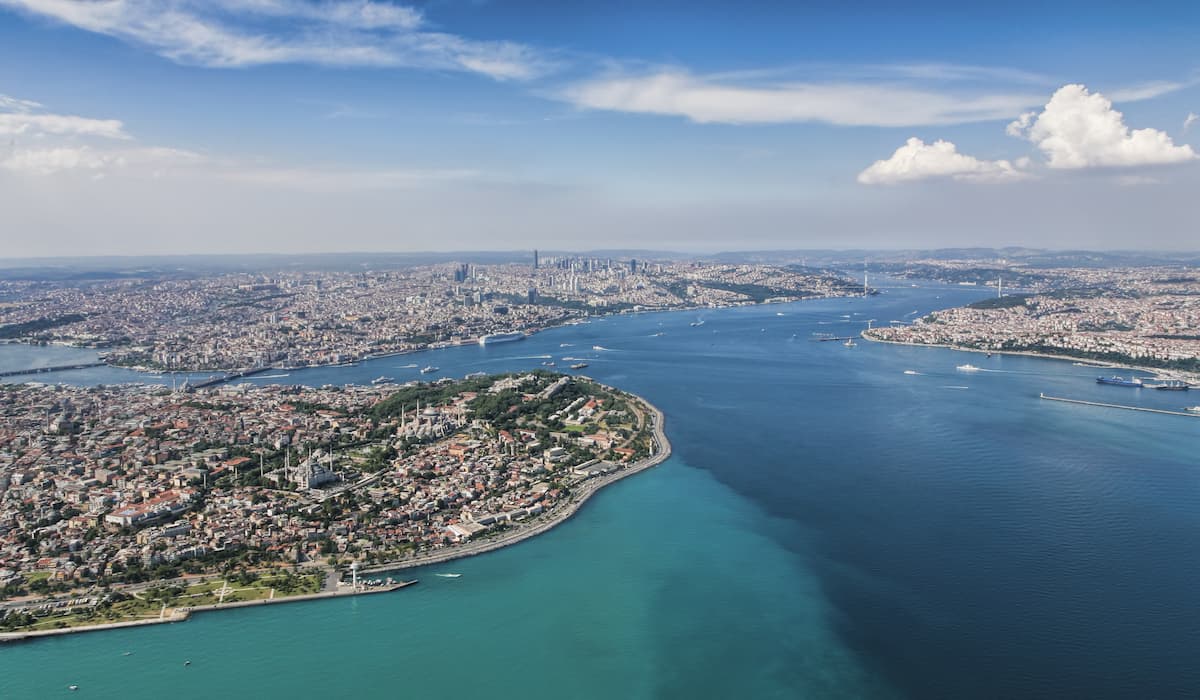
Dolmabahçe sits on a stretch of shore that rewards a full day. The most natural pairing is the Bosphorus cruise; the quay is a short walk, and seeing the palace facade from the water is the view it was designed for. Many pass tiers bundle the cruise, and our Bosphorus cruise pass benefits explain where to board and which side to sit.
On land, walk 10 minutes up to Beşiktaş for a market lunch, or take the funicular and tram toward Galata Tower and İstiklal Avenue for the afternoon; that half-day route is mapped in our Galata to Taksim guide. For a fully structured day that opens here, the second day of our 5-day pass plan runs from Dolmabahçe to the cruise to Galata in one clean line.
How to get to Dolmabahçe
Dolmabahçe is on the European shore at Beşiktaş, easy to reach without a taxi. From Sultanahmet, take the T1 tram to Kabataş (about 20 minutes), then it is a five-minute walk along the water. From Taksim, the short funicular drops you at Kabataş too. Ferries and the Bosphorus boats also call nearby check sailings on the Şehir Hatları timetable.
If you are landing the same day, our airport-to-first-stop guide covers the transfer options and how the pass handles them.
Plan your Dolmabahçe visit Set Dolmabahçe as a morning slot, pair it with the Bosphorus cruise next door, and let the pass handle entry so you walk straight to a timed group instead of queuing at the gate. Get your pass and start planning. |
Frequently asked questions
Is Dolmabahçe Palace included in the Istanbul city pass?
Yes. Entry to Dolmabahçe the Selamlık state rooms, the Harem, and the gardens is included with the pass. You show the QR code in the app at the pass-holder counter by the main gate and are given a timed group slot, with no separate ticket purchase needed.
How much is a Dolmabahçe Palace ticket in 2026?
The full combined ticket covering both sections and the gardens is about 1,250 TL (≈ $39 USD, May 2026). A Selamlık-only ticket costs less but skips the Atatürk room. Prices change through the year, so confirm before you travel; the pass covers the combined entry either way.
How long does a visit to Dolmabahçe take?
Plan 1.5 to 2 hours for both the Selamlık and the Harem, plus 15 minutes in the gardens. Visits are guided in groups along a fixed route, so the pace is set for you; there is no lingering or backtracking once your group moves on.
What days is Dolmabahçe Palace closed?
Dolmabahçe is closed on Mondays. It otherwise opens 9 AM to 6 PM with last entry around 4 PM. State ceremonies occasionally close sections at short notice, so check the official National Palaces site on the morning of your visit.
Can I take photos inside Dolmabahçe?
No. Photography is not allowed inside the state rooms and the harem to protect the fabrics and finishes. You can photograph the exterior, the gardens, the clock tower, and the Bosphorus frontage freely, so keep the camera ready for outside.
Is Dolmabahçe or Topkapı the better palace to visit?
They are different experiences, not better or worse. Topkapı is the medieval Ottoman court, courtyards, treasury, and a hilltop over the Golden Horn. Dolmabahçe is the late-empire baroque palace of chandeliers and crystal. With a pass covering both, most five-day visitors see each on separate days.
Useful Turkish for your visit
saray (sah-RAH-yuh) palace Dolmabahçe Sarayı means Dolmabahçe Palace
Selamlık (seh-LAHM-luhk) the public state rooms of an Ottoman residence
Harem (hah-REM) the private family quarters, off-limits to outsiders in their day
çay (chai) tea offered everywhere, often free
ne kadar? (neh kah-DAR) how much? handy at markets and stalls